
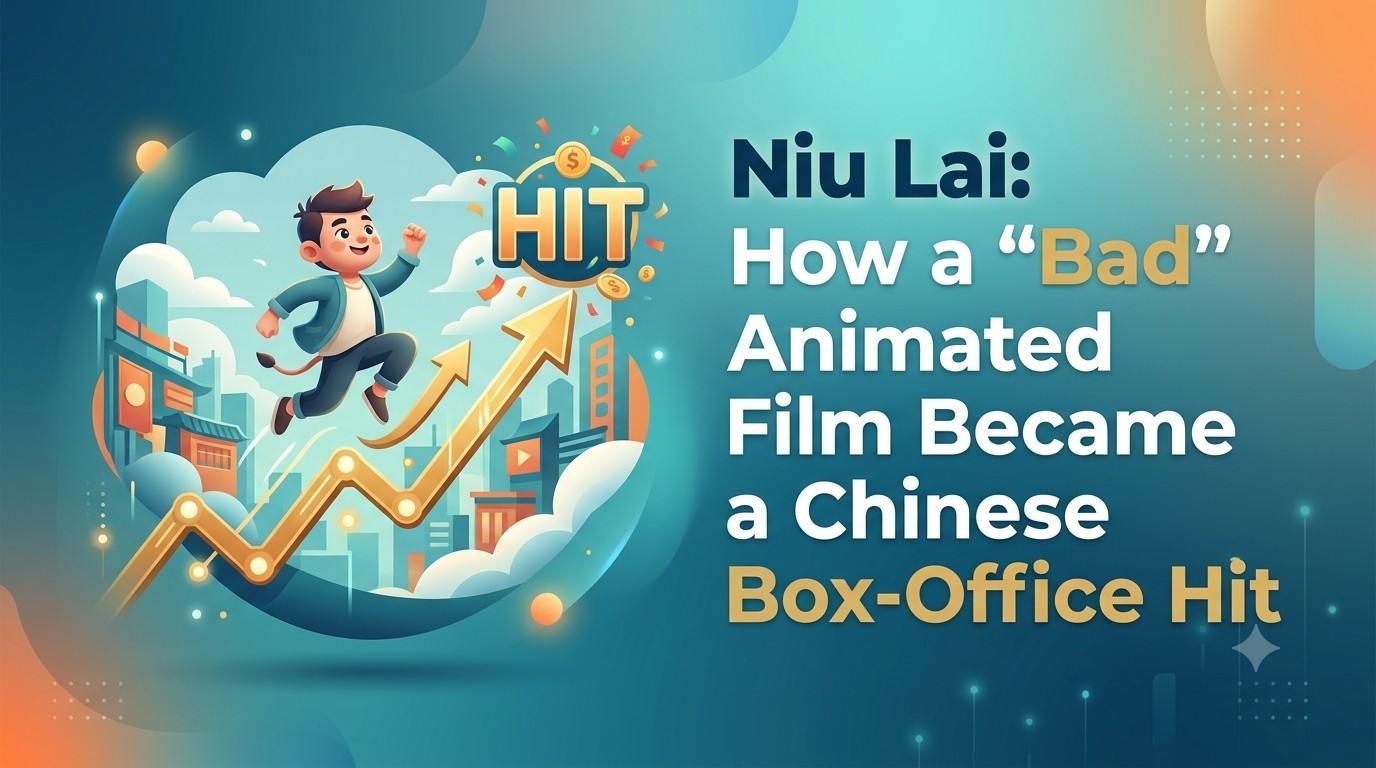
In the entertainment industry where it feels like everything is riding on costly productions, flashy visual effects, well known directors, and yes increasingly clever AI tools, success usually looks like a kind of recipe: spend more, push the marketing harder, and hand over a very polished product. Still Niu Lai, a low budget Chinese animated film, kinda slipped out of that whole pattern and ended up as one of the strangest movie stories this year. At first people mocked it for its rough animation and strange narrative, like it was all wrong, but somehow the same imperfections made more people actually watch it.
What began as a release that wasn’t doing great turned, surprisingly fast, into a social media thing. Viewers passed around clips, little jokes , memes and raw reactions, and instead of letting the criticism sink it, they flipped it into curiosity. The film’s weirdly high attention also brings a bigger doubt into the room: when digital entertainment is ultra finished, and AI generated content is everywhere, do audiences sometimes connect better with something that feels imperfect, personal, and genuinely human. Niu Lai kinda hints that the answer might be more tangled than the old rules of filmmaking tell us.
What Is Niu Lai?
Niu Lai, translated as “The Cow Is Coming” or “Here Comes the Cow,” is a Chinese animated film that in August 2026 became an unexpected kind of theatrical sensation. It kinda follows a young calf, and it goes into themes like growth, friendship, bravery, love, and giving things up. The basic story, honestly, is way more conventional than all the internet noise around it, but the film’s rough, uneven presentation is what really became the main thing people remember.
Instead of polished studio-quality animation audiences got stiff character motions, simple 3D characters, clunky dialogue, visual inconsistencies, and some sort of unusual narrative rhythm that feels off in a specific way. Those weak points, they turned into the whole reason the movie got attention online.
Why Did Niu Lai Go Viral?
Niu Lai’s popularity didn’t start because of a giant advertising push. The film opened in China on August 5, and at first it did extremely poorly. Several reports say it made only about 7,000 to 10,000 yuan during its first theatrical stretch, and that fewer than 300 tickets were sold within its first ten days, which, yeah, is not much.
Then social media, it just flipped the script. People started posting about it, not really because it was “good,” but because the animation and storytelling are so odd. Instead of the usual kind of praise, a big share of early attention came from viewers laughing at it or just questioning what they were even watching.
That created a powerful curiosity loop:
People heard it was terrible → watched clips → shared reactions → more people became curious → cinemas added interest and screenings → the film became a cultural talking point.
This is a fascinating example of viral movie marketing happening almost organically.
From Mockery to Movie-Going Curiosity
One of the most interesting parts of the Niu Lai phenomenon is this… negative attention did not always, honestly, discourage audiences. Instead it sort of did a weird thing where it gave people, a fresh reason to watch. When viewers kept seeing social-media posts that described the film as unusually bad (like, over and over) some just wanted to see it for themselves. The movie then stopped being mostly about traditional cinematic quality, and became more about joining in on this shared internet moment , you know, the whole thing together.
This also shows how social media movie trends can steer theatrical behavior. People were not only buying tickets because they expected a great animated film. They were also buying tickets because everyone was talking about that strange one, in that same way.
The “So Bad It’s Good” Effect
Niu Lai sits in a long lineage of films that get popular, partly because audiences end up enjoying the flaws. The “so bad it’s good” idea has been around for decades, with viewers turning technically weak or just unusual movies into cult entertainment. What feels different here with Niu Lai is how fast social media made the reaction grow.
Instead of needing years to build a cult following, clips and jokes basically let audiences reshape the movie’s reputation within days. So the film offers this kind of rare case where the cult-movie vibe develops in real time, not like in slow motion, and not after a long stretch of silence.
A Film Made by a Mother-and-Son Team
Behind the internet jokes is a remarkably personal production story. Niu Lai was created by Xin Yumeng and his mother, Sun Lifang, who reportedly worked on the project for around five years. The small team handled much of the film’s creative work themselves, including animation, writing, voices, music, and other production responsibilities. Reports also describe the production as extremely low-budget and made without the resources normally available to professional animation studios.
That background has influenced how some viewers perceive the movie. Once audiences learned how much time and personal effort had gone into the project, the film became more than an internet joke. For some viewers, it became a story about persistence and independent creativity.
The Human Side of the Film
The emotional response to Niu Lai is partly connected to its imperfections. Like, a bigger studio can pour out enormous sums, refining a character’s movement, the lighting, the facial expression, the sound, and even the visual effects—so much care. Niu Lai clearly doesn’t reach that kind of technical polish, not even close.
But audiences can still see signs of real people making decisions, learning in real time, experimenting, and then trying to push through a difficult creative project. And that’s helped feed the larger human-made animation conversation about the film, especially now, when AI-generated creative content is showing up more and more often.
Why the Film’s Imperfections Matter
In most normal reviews, poor animation would usually be treated like a major flaw. In Niu Lai’s case though, those same weaknesses became part of the marketing, almost like they were allowed to be visible. Its stiff movements, rough models, odd visual choices, and unconventional storytelling make the movie instantly recognizable. Viewers could spot it from a short clip, because it simply looked unlike the conventional animated stuff people are used to.
That points to a useful principle of content differentiation: sometimes a distinctive weakness can end up being more unforgettable than a generic strength. And the lesson isn’t saying creators should deliberately make bad work. It’s more that originality along with recognizability can pull attention in ways that technical perfection just can’t.
Niu Lai and the Rise of Anti-AI Sentiment
Another reason the film has started to get attention is sort of the way it ties into the ongoing conversation about AI generated creative work. A few reports have pointed out that the movie was made without AI, even though its crude visuals get mentioned sometimes in a joking way, like they resemble AI generated animation. Some viewers have latched onto that as a sign of how important human effort is, and how handmade creativity still matters. But this doesn’t mean audiences are automatically rejecting AI technology.
Instead, Niu Lai is showing that there can be real emotional value in knowing something was made directly by people, even if the end result looks a bit technically off. That difference may end up mattering more and more as people meet more synthetic content online.
Why authenticity can be stronger than polish
Modern digital platforms are packed with ultra edited videos, polished photography, AI images produced at speed, automated captions, and entertainment that looks carefully tuned for maximum impact. As all this stuff becomes simpler to make, the polished look might feel less special.
Niu Lai works as an odd sort of counter example here. Its limits make the whole making process easier to spot. You can basically feel that the creators did not have unlimited resources, and that what you see is shaped by their own personal skill, not some invisible pipeline. This lines up with a wider authenticity bent in entertainment, where audiences increasingly look for personality, behind the scenes stories, and creative imperfections that refuse to be fully smoothed out.
Social Media Became the Film’s Marketing Department
Niu Lai reportedly entered cinemas with little conventional promotion. There was no major publicity campaign comparable to large studio releases. Instead, audiences effectively became its marketing engine.
People shared:
- Funny scenes.
- Screenshots.
- Memes.
- Reaction videos.
- Edited posters.
- Discussions about the animation.
- Comparisons with other films.
This user-generated activity ended up creating this huge amount of organic film promotion ,but it never really used the usual advertising playbook. The irony is, a lot of the people actually promoting the movie were first, you know, making fun of it in the beginning ,and then somehow it turned around.
Cinemas joined the conversation
The viral attention got so big that cinemas started responding to all the public interest. Some reports mention that certain theatres made their own little promotional sets, like hand-drawn posters, because the film didn’t have the usual marketing “machinery” you’d expect from a major release. It’s kind of an odd detail in the whole thing too.
Rather than a studio steering the entire marketing narrative, audiences and cinemas helped build it in a natural way. The movie essentially turned into a case study for audience-led movie promotion, where curiosity from the public turned into real commercial momentum.
The box office turnaround
The financial shift is probably the most surprising part of all this. It started off with what sounds like only a few thousand yuan in early earnings, then as online buzz grew, the box-office total climbed into the millions. Different outlets have reported different numbers at different moments during its fast-moving run ,but the overall direction stays obvious: something that seemed like it might fade out suddenly became a big talking point.
By mid-August, coverage put the earnings well past the early performance, with some articles putting the total over 14 million yuan ,and later updates showing it kept increasing. The exact amount will keep moving as the run continues ,but the main takeaway is that dramatic reversal.
Why Curiosity Can Sell Movie Tickets
Traditional marketing usually tries to convince audiences that a movie is worth watching.
Niu Lai created a different proposition:
“You have to see this to understand it.”
That can be amazingly powerful, if you think about it. Curiosity creates this information gap, kinda. When people keep running into something unusual but they never really get it, they might end up wanting to experience it themselves , personally. The film sort of turned into an internet curiosity movie, and it made confusion feel like a good reason to actually buy a ticket , right there.
The Power of Memes in Modern Cinema is a real thing now
Memes aren’t separate from entertainment marketing anymore. A movie can slip into internet culture through one single image, a quote , a line, a character, a scene, or even some weird production detail. Niu Lai shows pretty clearly how memes can take an unknown film and make it into a recognizable cultural object.
And even people who had zero intention of watching a low budget Chinese animation ended up knowing its name anyway. That is one of those useful lessons from meme driven entertainment marketing: attention doesn’t always start with admiration. Sometimes it starts with surprise, like someone just told you something and you’re still processing it.
Not Everyone thinks the Success Is Positive, though
It matters that we don’t pretend Niu Lai is universally praised. Some critics and industry observers have questioned the film’s technical quality and also the amount of attention it got. A few people argued that the success shows the power of internet culture more than it shows cinematic achievement. Others have raised worries about what this kind of phenomenon says about audience expectations and the wider film industry. So yeah, that criticism is also part of the story.
The film’s success doesn’t mean production quality doesn’t matter anymore. Instead, it suggests that cultural relevance and entertainment value can sometimes move on their own, even when they don’t match the usual quality measures.
What Creators Can Learn From Niu Lai
The story offers several useful lessons beyond filmmaking.
1. Being Different Can Create Attention
A project that looks and feels different can stand out more easily than something that follows familiar formulas.
2. Audiences Can Become Marketers
When people have strong reactions to content, they may spread it without being paid to promote it.
3. Authenticity Can Create Emotional Value
Knowing the story behind a project can change how audiences interpret its imperfections.
4. Curiosity Is a Powerful Marketing Tool
People may engage with something simply because they want to understand why everyone is discussing it.
5. Viral Success Is Difficult to Manufacture
Niu Lai benefited from a highly unusual combination of timing, social behavior, humor, curiosity, and cultural context. Creators should not assume that making something intentionally bad will automatically reproduce the same result.
Is Niu Lai Actually a Good Movie?
It kinda depends on what you expect from it. If your standard is polished animation , sophisticated visual effects, refined voice acting, and conventional storytelling then yeah the film may disappoint. But if you approach it as an odd kind of cultural moment, sort of an example of independent filmmaking, then the experience can feel more interesting, a little off, but better.
The most accurate way to describe Niu Lai might be that it’s more fascinating as a phenomenon than as a conventional animated blockbuster , you know.
Why Niu Lai Matters Beyond China
The film’s story lines up with a few global trends happening at the same time. Like the growth of social media driven discovery, the rise of meme culture, increasing access to digital production tools, and also the worries around AI generated creative content. It even suggests that audiences can get curious about material that doesn’t follow expectations.
In a world where creators are always trying to make everything look perfect, a visibly imperfect project can feel strangely fresh. Maybe that’s part of why Niu Lai has gotten attention beyond its original market too.
The Bigger Lesson About Viral Success
The most important lesson is not that “bad content” can become successful, even if that sounds like a catchy headline. The deeper lesson is, audience attention does not always follow those older, traditional quality metrics, or whatever people call them.
People react to stories, feelings, humor, novelty, community, controversy, and that itch of curiosity. Technical quality matters, sure, but it’s only one ingredient and not the whole recipe. Niu Lai sort of… happened, in the end, to stack a bunch of unusual factors at exactly the right moment. That makes the success hard to recreate, but also kind of fascinating to study.
Conclusion
Niu Lai is one of 2026’s strangest entertainment stories because a film that was first brushed aside for its crude animation and odd, uneven storytelling managed to turn online mockery into real box office momentum. It was made by a mother-and-son team over several years, and then it found its audience through social media, memes, pure curiosity, and a slow growing appreciation for its unmistakably human flaws.
Its success does not mean technical quality has become irrelevant, and it also does not “prove” that every low budget project can become a viral hit. Instead, it suggests modern entertainment is wildly unpredictable, especially when audiences not traditional advertising campaigns start steering the conversation. In an increasingly shiny, AI-assisted media world, Niu Lai ends up being an unexpected reminder that originality, authenticity, and even imperfection can sometimes pull attention that money alone can’t really buy.
Frequently Asked Questions
1. What is Niu Lai about?
Niu Lai is a Chinese animated film centered on a calf and themes of growth, friendship, courage, love, and sacrifice. Its unusual production style helped make it an internet sensation.
2. Why did Niu Lai become popular?
The film initially attracted attention because audiences mocked its crude animation and unusual storytelling. Social-media sharing and memes then transformed that criticism into curiosity and theatrical interest.
3. Who made Niu Lai?
The film was created by Xin Yumeng and his mother, Sun Lifang, who reportedly worked on the project for around five years and handled many of its creative responsibilities themselves.
4. Is Niu Lai an AI-generated movie?
Reports describe the film as being made without AI. Its handmade, low-budget production has become part of the discussion around its unexpected popularity.
5. What can creators learn from Niu Lai?
The film demonstrates the value of distinctiveness, audience participation, curiosity, authenticity, and organic word-of-mouth. However, its success is unusual and should not be treated as a predictable formula for viral success.





Leave a Reply