
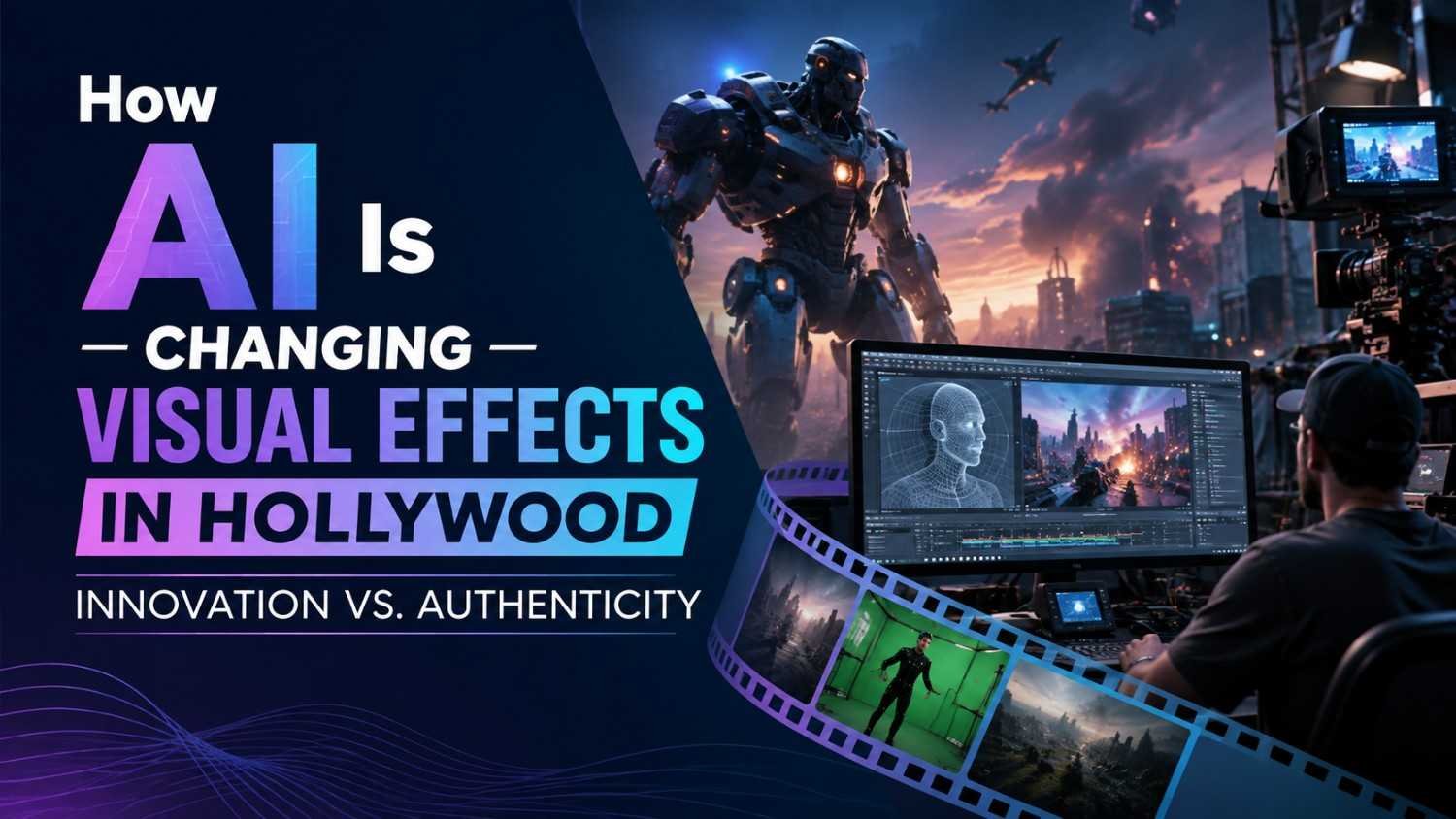
Hollywood has always sort of grabbed onto technological innovation so it can make films feel more immersive and visually astonishing. From practical effects and tiny miniatures to Computer-Generated Imagery (CGI), each big leap has shifted the way stories get made and shown. Now there’s another major shift happening, Artificial Intelligence (AI) is the one everyone is talking about. With AI-powered tools, filmmakers can make more lifelike visual effects, sooner, and they can also handle a bunch of those repetitive editing duties that eat hours. It can support motion capture, boost facial animations, and even rebuild scenes and environments that used to take months of manual effort .Even so, the promise of faster workflows and more creative room comes with sticky questions. Like, what about originality, artistic integrity, and whether machines could end up substituting the human creativity that has been, honestly, the heart of filmmaking this whole time.
And since AI has rolled into Hollywood fast, you can hear debates everywhere, among filmmakers, actors, VFX artists , and audiences. People who support it argue that AI may cut production costs, speed up post-production, and free up creative professionals so they focus on storytelling instead of all that grindy technical work. Critics , though, are uneasy about job displacement, too much dependence on automation, digital replicas of actors, and a gradual fading of real hands-on craftsmanship. So the actual problem isn’t simply choosing AI or human creativity , it’s figuring out the right balance, where technology acts as an amplifier not a replacement for artistic intention. This piece looks at How AI Is Changing Visual Effects in Hollywood, weighing Innovation vs. Authenticity, and it digs into the benefits, the obstacles, the ethical implications, and what the future might bring for the entertainment industry.
Why Hollywood Is Turning to AI
The demand for top-notch visual effects has never been higher, honestly. Nowadays audiences kind of sort of expect realistic environments, believable digital characters, and action that flows smoothly in almost every big movie. But the usual VFX process can still mean hundreds of artists, working for months. or even years, just to finish one film. Artificial Intelligence can help studios tighten up these complicated pipelines, not by replacing the craft, but by taking over repetitive chores, so the artists get to spend more time on the creative call—those subtle decisions that really matter.
Key Reasons AI Is Being Adopted
- Speeds up production timelines.
- Reduces repetitive manual work.
- Enhances visual realism.
- Improves production efficiency.
- Supports creative experimentation.
Rather than replacing filmmakers, AI is becoming a valuable production assistant.
1. AI Is Speeding Up Post-Production
Post-production is one of the longest phases of filmmaking. Editors, VFX artists, and animation teams often spend months refining scenes before a movie reaches cinemas. AI-powered software can automatically remove unwanted objects, stabilise footage, enhance image quality, identify editing cuts, and organise massive video libraries. These automated processes reduce production time while maintaining professional-quality results.
Benefits
- Faster editing workflows.
- Improved scene organisation.
- Reduced repetitive tasks.
- Higher production efficiency.
- Quicker project delivery.
Human editors still make the final creative decisions, but AI significantly reduces technical workload.
2. Smarter CGI Creation
Creating realistic CGI characters and environments traditionally requires enormous amounts of manual modelling, lighting, rendering, and animation. Artificial Intelligence now assists artists by generating textures, predicting lighting behaviour, improving object tracking, and automating certain animation processes. These improvements allow VFX teams to create highly detailed digital environments much more efficiently.
AI Improves CGI By
- Enhancing texture generation.
- Automating background creation.
- Improving rendering efficiency.
- Supporting realistic lighting.
- Assisting object movement.
Artists remain responsible for creative direction while AI accelerates production.
3. More Realistic Facial Animation
One of AI’s biggest contributions to modern filmmaking is improving digital facial animation. Machine learning algorithms analyse thousands of facial expressions to create realistic eye movements, lip synchronisation, and emotional expressions for digital characters. This helps animated films and CGI-heavy productions achieve greater realism.
Advantages
- Natural facial expressions.
- Better lip synchronisation.
- Improved emotional realism.
- Faster animation workflows.
- Enhanced audience immersion.
This technology is particularly valuable for animated films and fantasy productions.
4. Revolutionising Motion Capture
Motion capture allows actors’ physical performances to be translated into digital characters. AI enhances this process by cleaning captured movement data, correcting errors automatically, predicting missing body movements, and reducing manual adjustments during animation.
AI Supports Motion Capture Through
- Improved body tracking.
- Faster error correction.
- Better movement prediction.
- Reduced animation cleanup.
- More natural character movement.
This allows actors’ performances to remain central while improving technical accuracy.
5. AI-Powered De-Aging and Digital Recreation
Hollywood increasingly uses AI to digitally de-age actors or recreate younger versions of performers for flashback scenes. Advanced AI systems analyse facial structures, historical footage, and skin textures to generate highly realistic digital appearances while preserving an actor’s original performance.
Common Applications
- Younger character versions.
- Historical recreations.
- Franchise continuity.
- Digital doubles.
- Performance enhancement.
These techniques save time compared to fully manual visual effects work.
6. Creating Massive Digital Environments
Many blockbuster films feature cities, planets, battlefields, and fantasy worlds that would be impossible or prohibitively expensive to build physically. AI helps generate detailed landscapes, buildings, vegetation, weather effects, and environmental variations much faster than traditional modelling techniques.
Environmental Improvements
- Procedural landscapes.
- Smarter asset generation.
- Faster world building.
- More detailed environments.
- Reduced production costs.
Artists then refine these environments to match the film’s creative vision.
7. Better Crowd Simulation
Scenes involving thousands of people once required extensive manual animation or large numbers of extras. AI-powered crowd simulation creates realistic digital populations with natural movement, individual behaviours, and dynamic interactions.
Benefits
- Realistic crowd behaviour.
- Lower filming costs.
- Larger-scale action scenes.
- Faster production.
- Improved scene realism.
This technology is widely used in historical epics and action films.
8. Restoring Classic Films
Artificial Intelligence is also helping preserve cinema history. Older films can now be restored using AI that removes scratches, repairs damaged frames, enhances image quality, increases resolution, and improves colour consistency without changing the original storytelling.
Restoration Benefits
- Higher image quality.
- Better colour restoration.
- Reduced visual damage.
- Improved archival preservation.
- Greater accessibility for modern audiences.
- AI helps preserve cinematic heritage for future generations.
9. Ethical Concerns Surrounding AI
Despite its benefits, AI introduces several ethical questions that Hollywood must address responsibly. The ability to digitally recreate actors raises concerns regarding consent, ownership, compensation, and misuse. Deepfake technology also highlights the importance of protecting performers’ identities and maintaining public trust.
Major Ethical Challenges
- Digital actor rights.
- Consent and permissions.
- Intellectual property.
- Deepfake misuse.
- Fair artist compensation.
Responsible policies are essential for sustainable AI adoption.
10. Will AI Replace VFX Artists?
One of the biggest misconceptions is that AI will eliminate creative jobs. In reality, AI performs repetitive technical tasks exceptionally well but lacks the imagination, storytelling ability, artistic judgement, and emotional understanding that experienced VFX professionals contribute.
Human Creativity Still Matters
- Storytelling decisions.
- Artistic vision.
- Creative problem-solving.
- Emotional expression.
- Director collaboration.
AI works best as a creative assistant rather than a replacement.
Innovation vs. Authenticity: Finding the Right Balance
Hollywood’s biggest challenge is trying to balance technological progress with real, lived storytelling. Viewers often want those jaw-dropping visual marvels, yet they also seem to care about credible acting , honest feeling moments , and a sort of artistic uniqueness. If studios over rely on AI created visuals, especially when there’s no real purpose behind the scenes, the result can be kind of stunning on the surface but thin emotionally , like it doesn’t really land.
The filmmakers who do well will probably blend AI speed and efficiency with human imagination. In that way the tech handles the more technical chores, while the artists can stay locked in on plot, personality building, and that deeper emotional resonance.
The Ideal Balance Includes
- Technology supporting creativity.
- Human-led artistic decisions.
- Ethical AI implementation.
- Respect for performers.
- Focus on storytelling over spectacle.
This balanced approach benefits both filmmakers and audiences.
Best Practices for Responsible AI in Hollywood
As AI adoption grows, studios should establish clear guidelines to ensure ethical and transparent use.
Recommended Practices
- Obtain actor consent before digital recreation.
- Clearly disclose AI-assisted production where appropriate.
- Protect artists’ intellectual property.
- Train creative teams to work alongside AI.
- Maintain human oversight for all creative decisions.
- Invest in workforce upskilling.
- Prioritise storytelling above automation.
Responsible implementation builds trust across the industry.
What the Future of AI in Hollywood Looks Like
Artificial Intelligence is expected to turn into a kind of standard production tool not really as a replacement for filmmakers. In the near future, AI systems will probably help with script analysis, virtual production, pre visualization , multilingual dubbing, scene planning, and also real-time rendering. And yeah, as the technology keeps evolving, the studios that end up thriving won’t be the ones that just “have AI”, but the ones that blend these cutting-edge AI abilities with real artists, directors, writers, and performers. So the future of cinema, I mean it won’t be shaped by machines alone, it’ll be shaped by creative professionals who understand how to use AI responsibly… to make stories feel more convincing and alive.
Conclusion
Artificial Intelligence is changing Hollywood and Visual Effects, making filmmaking quicker, more efficient, and more inventive over time. From smarter Computer Generated Imagery , realistic facial animation, and AI-assisted editing to digital environments, these tools are opening all sorts of promising options for the entertainment industry. Still, real cinematic excellence is not something you can fully automate, it depends on human imagination, ethical choices, and storytelling that feels genuine. Instead of swapping out artists, AI in filmmaking should act like a strong creative partner, one that supports production while keeping the emotional texture audiences care about most. As Hollywood keeps embracing innovation, finding the right balance between technological progress and artistic authenticity will stay the main thing for creating films people will remember for years to come.
Frequently Asked Questions
1. How is AI being used in Hollywood visual effects?
AI helps automate editing, improve CGI creation, enhance facial animation, optimise motion capture, restore classic films, and generate realistic digital environments, making production faster and more efficient.
2. Will AI replace visual effects artists?
No. AI can automate repetitive technical tasks, but creative storytelling, artistic direction, and emotional design still require skilled human professionals.
3. What are the ethical concerns of AI in filmmaking?
Key concerns include digital actor consent, deepfake misuse, intellectual property rights, fair compensation, and ensuring transparency in AI-assisted productions.
4. Does AI reduce movie production costs?
Yes. AI can shorten production timelines, automate labour-intensive tasks, reduce repetitive work, and improve workflow efficiency, helping studios manage resources more effectively.
5. What is the future of AI in Hollywood?
AI is expected to become an essential creative tool that supports filmmakers with editing, animation, visual effects, virtual production, and content creation while keeping human creativity at the centre of storytelling.





Leave a Reply