
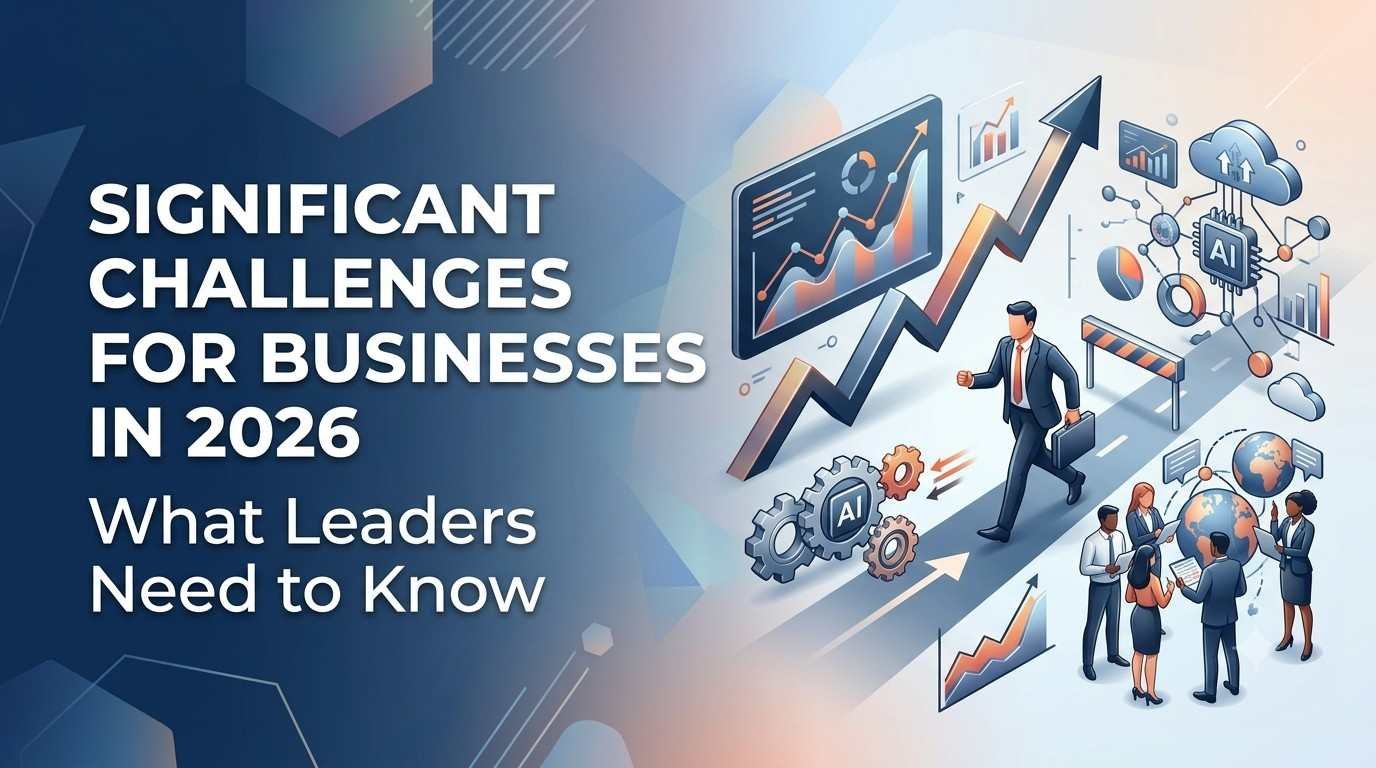
In 2026, running a business is not only about a strong product, tight spending, and steady sales. The world around a company keeps shifting in linked ways. Pay and hiring plans can change when the economy feels shaky. Supplies can get delayed when countries clash. Work itself can be reshaped as artificial intelligence spreads. Then there is cyber risk, which can knock systems offline with little warning. Many teams are not short on opportunities. The bigger issue is timing. New chances and new dangers show up faster than some groups can adjust. Leaders say the same themes keep coming back. They point to cyberattacks, supply-chain disruptions, difficulty hiring skilled people, political uncertainty, the state of the economy, new rules, and AI.
Tech adds another layer. Firms are putting a lot of money into AI. Still, some leaders ask if those projects are paying off in real results, not just promises. IT spending worldwide is expected to rise to about $6.37 trillion in 2026, and AI tools and gear are a part of that rise. Even so, companies feel pressure to prove the value of what they spend on technology. The World Economic Forum also warns about 2026. It calls out rising cyber risk, more split-up geopolitical ties, and a growing gap between those with new tech and those without it. So the goal for many companies is not only faster growth. It is to change quickly when needed, stay tough under stress, protect systems, and run with clear discipline.
1. Economic Uncertainty and Rising Costs
A major business risk that 2026 adds is economic uncertainty. Many firms are stuck with shifting interest rates, ongoing inflation, higher energy bills, moving exchange rates, and stop and start consumer spending. When these factors shift, forecasts become less reliable fast. Ideas that seemed solid early in the year can turn out wrong before plans are fully rolled out. No company can fully steer the economy, but leaders can prepare for what might come next. Rather than betting on one budget path, teams can map out several cases for sales, expenses, demand, and cash flow.
Practical priorities include:
- Protecting cash flow.
- Reviewing fixed and variable expenses.
- Building realistic financial scenarios.
- Avoiding unnecessary long-term commitments.
- Monitoring changes in customer spending.
This method changes economic doubt from a vague issue into something leaders can plan for.
2. Artificial Intelligence Is Creating Both Opportunity and Risk
AI may be the most noticeable force shaping business trends in 2026. Many firms are already using it in customer support, ads, code work, data review, fraud spotting, studies, and day to day office tasks. Still, copying what rivals do can backfire. It can lead to high costs with little payoff. To avoid that, a company needs dependable data, clear rules for use, strong cyber defenses, trained staff, and goals that can be tracked. PwC’s 2026 India CEO survey reported that 66% of CEOs in India said they worry more about staying current with tech and AI than the wider global share of 42%.
So the real question has changed. It is not only, “Should we use AI?” It is: “Where does AI bring real business results, while not adding risks we cannot accept?”
More companies are moving from short tests to tighter rollout plans. That change is turning into a key AI problem for businesses in 2026.
3. Proving AI Return on Investment
AI investment brings a second problem. It is not enough to buy tools and say they work. Firms also need proof that the work improves daily results. Spending on software, cloud, outside help, and training is easy to track. The payoff is harder to see in numbers. Many teams are now talking about an “AI ROI paradox.” They spend a lot, yet they still get pushed to show clear gains. Leaders must link each AI effort to real business targets. They should not focus only on rollout counts.
Take a customer service case. You can watch response speed, how many issues get solved on the first try, customer ratings, and support costs. A marketing AI use case can be checked with better qualified leads, higher conversion, lower cost to acquire, and added revenue. The best adoption plan starts with a business issue. Then you match the tool to that need.
4. Cybersecurity Threats Are Becoming More Serious
Cybersecurity is no longer only an IT matter. For many companies, it is a board-level concern. One attack can stop operations. It can leak customer data. It can harm trust in the brand. It can also trigger rules and fines.
PwC’s 2026 CEO research flags cyber risk as a top threat for companies. The World Economic Forum also notes that AI is changing both sides of security, including attacks and defense.
AI based attacks can make things harder. Bad actors can use tools to speed up phishing, scams, tricks, and other harmful acts. Recently, over 100 large tech and money companies asked for stronger protection against cyberattacks that use AI. They also pointed to how urgent the situation is right now. Because of this, firms should handle cybersecurity challenges in 2026 as a steady resilience task, not as a checkbox task done once in a while.
5. The Talent and Skills Gap Keeps Widening
Tech moves quickly. Many old job descriptions do not match what the work now needs. Teams often require people who can work with AI, security, data, automation, cloud systems, and digital marketing. They also need help with newer and more complex business systems. Still, hiring more staff does not always solve the issue. There is stiff competition for people with niche skills. That can raise costs. Many groups also struggle to find enough candidates who have the right mix of technical know how and business knowledge.
A Forbes cited study reported that 37.2% of leaders said finding qualified workers is a top concern. On top of that, AI skills make the talent mismatch even harder to manage
A practical talent shortage in business strategy should include:
- Upskilling existing employees.
- Creating internal AI training programs.
- Hiring for adaptable skills rather than only specific tools.
- Using automation to reduce repetitive workloads.
- Building partnerships with external specialists when necessary.
Firms that invest in their workforce often adjust more easily than firms that rely only on hiring.
6. Supply chain problems
Supply chains still get hit by wars, border issues, shipping slowdowns, tariffs, fuel costs, weather, and vendor breakdowns. A business can have solid products and strong sales, yet it can stall if one key part stops arriving. Recent executive work lists supply chain disruption as one of the biggest threats in 2026. In India, the FICCI-EY Risk Survey 2026 reported that 54% of people said supply chain disruption was a worry for day to day operations and ongoing business.
Because of that, supply chain strength can act like an edge in the market, not just an internal task. Teams can raise resilience by using more than one supplier, tracking what matters most, keeping sensible stock levels, and setting up backup sources. The aim is not to stop every risk. It is to keep one setback from shutting down the whole operation.
7. Political and trade uncertainty
Many companies now work in more than one country. That means politics can shift prices, delivery timelines, investment choices, and what customers buy. Tariffs, trade limits, local fighting, sanctions, and strained diplomacy can change the math of global work fast. The World Economic Forum pointed out that geopolitical fragmentation is a big driver that is reshaping cyber and business risks in 2026.
Companies should add geopolitical possibilities to their risk planning. That means checking which areas are fragile, where key suppliers are located, which delivery routes are at risk, and what income streams could be hit. A strong firm should not act like the world it runs in today will stay the same.
8. Shifts in what customers expect
Many buyers now want faster service, easy steps, tailored offers, clear information, and solid online tools. What worked a few years back may not work now. Tech also helps people compare quickly. They can look up rivals, check costs, read ratings, and move to another provider without much hassle.
This makes a clear hurdle in 2026. Teams need to know more than what people purchase. They should also track why customers pick one business instead of another. Ongoing customer studies, feedback review, social listening, and behavior signals can show changes early, before sales start to drop.
9. More pressure on rules and compliance
Rules keep getting harder to follow. Governments are reacting to AI, privacy issues, cyber threats, climate and environmental matters, money practices, and digital services. For a company, it is not enough to list the laws on paper. The real work is understanding how each rule fits daily operations. It also means watching for changes over time.
Executive research puts regulation high on the list of worries for businesses in 2026. Indian firms face the same kind of changes around technology and data. Because of that, good governance matters even more. Businesses should build compliance into processes instead of treating it as paperwork completed at the end of a project.
10. Data Privacy and Governance
Data is now a key asset for many companies. It also brings serious exposure. Firms pull in facts from customers, staff, vendors, web pages, apps, and linked platforms. With AI in the mix, governance becomes harder. Teams may rely on private data to train models, tailor outputs, or run automated tasks.
A solid governance plan should spell out access rules. It should also cover storage methods and permitted use. It needs retention timelines and clear steps for incidents. When data is handled well, AI work can improve too. Models perform better when the input is dependable.
11. Technology Integration Problems
Getting new tools can be quick. Making them work with what is already in place is not. Many groups end up with separate systems for billing, sales contacts, ads, people work, stock, reporting, and messaging.
If these tools do not connect, workers may copy and move data by hand. That takes extra time. It also raises the chance of mistakes. So the main digital shift is not just adding another product. It is creating a setup where tools can communicate. The goal is simpler daily work, not added steps and extra confusion.
12. The Cost of Digital Transformation
Digital transformation can boost output and how customers feel, but it does not come for free. Companies often have to fund new software, servers, security controls, expert help, staff learning, system connections, and regular upkeep. This is tough for small and mid-sized firms that have tight budgets.
It is not always about skipping digital change. A better path is to pick efforts that fix specific, trackable issues. A smaller rollout that clearly lowers costs or lifts sales can beat a big program when goals are vague.
13. Keeping Business Resilience
Resilience is now a key theme in many business challenges. The expectation is simple. Firms must keep running even when something breaks down. A resilient organization has backup plans. It also uses different suppliers, keeps data safer, keeps cash options open, trains staff, and uses leadership steps that help teams decide fast.
The FICCI-EY 2026 survey notes that many groups face risks that link together. These include cybersecurity, shifts in customer needs, geopolitics, supply chain problems, technology issues, climate events, and governance matters. So, risk work cannot stay in one department. A shock in one area can spread fast and hit other parts of the business.
14. Climate and Environmental Risks
Climate issues are showing up more often in business plans. Bad weather can hit buildings. It can also disrupt staff routines, supplier schedules, transport routes, power prices, and insurance terms.
A FICCI-EY Risk Survey for 2026 said about 45% of people saw the money effects of climate change as a major day to day risk in India. Because of that, firms should look at climate exposure when they choose sites and vendors. They should also review logistics, shared infrastructure, and insurance coverage. This is not just about image. It can be about keeping core operations running over time.
15. Making Innovation Work in Real Life
Innovation matters, but trying new things too often can drain budgets. Some companies buy into every new tool. They do it before checking if it fixes a real customer need or a real work issue.
A better path is simple testing. Try a tool on a small scale first. Set clear goals that can be checked. Look at the results. Then roll it out only if the numbers and outcomes make sense. This matters in 2026, too, since AI, automation, cloud services, and other tools are moving fast. Moving quickly helps, yet staying on the right track matters more.
How Businesses Can Prepare for 2026 Challenges
The best response to business challenges in 2026 is not to create a massive list of fears. It is to build an organization capable of responding when conditions change.
Leadership teams can focus on five practical areas:
- Scenario planning: Prepare for multiple economic, geopolitical, and operational outcomes.
- Technology governance: Connect AI and digital investments to clear business objectives.
- Cyber resilience: Protect systems, identities, data, suppliers, and critical operations.
- Workforce development: Continuously develop skills instead of relying only on external hiring.
- Operational flexibility: Diversify suppliers, markets, technology dependencies, and revenue sources.
These points help each other. If teams build the right skills, they can use new AI tools. If security is tight, digital change is safer. If the budget plan is solid, companies can spend even when times feel unsure.
What small businesses should focus on
Small firms do not always have the same budget as big groups. Still, they can grow strong in the face of shocks. Some smaller organizations even move quicker, since choices can be made in less time. A small business should pick the threats that can hurt it most. Then it should tackle those first, instead of chasing every issue at once.
For many companies, the priority list might include:
- Secure customer and financial data.
- Maintain healthy cash reserves.
- Reduce dependence on one supplier or customer.
- Train employees in essential digital skills.
- Automate repetitive administrative work.
- Monitor changing customer behavior.
- Review insurance and contingency plans.
The aim is to build resilience for a small business, not to copy the setup of a large global firm.
Conclusion
In 2026, the hardest business issues will not show up as single problems. They will come as linked stress. AI, cyber threats, shaky economic conditions, hiring limits, supply chain gaps, new rules, higher customer demands, shifts in tools, and world events will all collide. Work done by researchers points to clear focus areas. Leaders are watching money swings, digital danger, tech shocks, gaps in skills, and backup options for the supply chain. At the same time, AI brings real chances, but it also brings fresh risks.
No one can foresee every disruption. Still, a business can get ready for the unknown. That means keeping tight control of finances, training staff well, protecting online systems, spreading risk across key vendors or tools, and choosing tech spending that can be checked with clear results. The firms most likely to do well may not be the ones that sprint in every direction. More often, they will be the ones that spot shifts early, choose actions with care, and adjust as needed without forgetting customers, staff, and long-term value.
Frequently Asked Questions
1. What are the biggest business challenges in 2026?
Major challenges include economic uncertainty, cybersecurity, AI disruption, talent shortages, supply-chain problems, geopolitical instability, regulation, and changing customer expectations.
2. How is AI creating challenges for businesses?
AI can create challenges involving investment costs, cybersecurity, data governance, employee skills, responsible use, integration, and proving measurable return on investment.
3. Why is cybersecurity important for businesses in 2026?
AI-enabled attacks, third-party vulnerabilities, fraud, and geopolitical tensions are increasing cyber risk, making cybersecurity an important business resilience priority.
4. How can small businesses prepare for business risks?
Small businesses can improve resilience by protecting data, maintaining cash reserves, diversifying critical suppliers, developing employee skills, and creating practical contingency plans.
5. What should businesses prioritize in 2026?
Businesses should prioritize resilience, cybersecurity, practical AI adoption, workforce development, financial discipline, customer experience, and flexible operations rather than chasing every new trend.







Leave a Reply