
Starting a business is exciting, yet a lot of entrepreneurs get kinda overwhelmed when they hear they need a business plan. You know, the whole thing—traditional plans can easily blow past 30 or 40 pages, and then suddenly you’re expected to do deep market analysis, financial projections, competitive research, plus this long documentation. Now, sure, the full version has its place , but most small business owners, freelancers, early startups, and first-time founders just want a solid path they can follow. Something clear, update-able, and usable, not a huge document that looks serious but never gets looked at. The tricky part is that a lot of business plans end up tucked in folders, rarely reviewed after they’re finished, so it becomes more of paperwork chore than a real business tool.
A One-Page Business Plan helps with that by going for clarity over complexity. Instead of trying to guess every possible business scenario, it helps you lay out your goals, your customers, your value proposition, your marketing strategy, your revenue model, and your key priorities, all in one place. That short plan is easier to build, simpler to revise, and way more likely to steer your day-to-day decisions. Whether you are launching a startup, growing an existing small business, or testing a new business idea, a one-page business plan gives you the framework to stay focused while still being flexible as things change around you.
What Is a One-Page Business Plan?
A One-Page Business Plan is basically a simplified take on a traditional business plan, it squeeze the important parts of your company into a single page. Rather than long papers full of extra stuff no one really needs, it points to your business intention ,your customers, your products or services ,your marketing approach, operations, money targets, and the key growth focus areas in a way that’s clear and usable. Its goal is not to swap out the detailed financial documents or the investor presentations when those are actually needed. Instead, it works like a practical companion that keeps business owners locked in on what matters while still reacting fast when the market shifts. Since it’s short and relatively easy to skim, lots of successful founders revisit and refresh their one-page plan regularly, sometimes even more than once a quarter.
Why Simplicity Often Leads to Better Execution
A lot of entrepreneurs think that if the business plan is longer it must be better, basically. But in practice, these intricate drafts tend to turn into something hard to keep updated, and they rarely shape the day to day choices that actually matter. A shorter plan feels almost too simple, yet it works, because it pushes you to move forward. It also helps you sort what’s essential from what’s just extra noise, so you don’t get stuck in needless particulars. The team can quickly orient itself to the company’s direction, investors can catch the main concept sooner, and business owners can treat the document like a living compass, not like a report that gets abandoned.
Benefits of a One-Page Business Plan
- Easier to create and update.
- Keeps goals clear.
- Encourages faster decision-making.
- Improves team alignment.
- Simplifies communication.
Step 1: Define Your Business Vision
Every successful business sort of starts with a clear purpose. Before you even think about products, marketing, or revenue, define why your business exists and what problem it s trying to solve, kind of directly. Your vision should spell out the long-term impact you want your company to create, while your mission explains how you’ll get there. Try not to lean on foggy statements, instead focus on the actual value customers can really grasp, not some abstract promise.
Ask Yourself
- What problem am I solving?
- Who benefits from my solution?
- What makes my business meaningful?
- Where do I want the business to be in five years?
A strong vision provides direction for every future business decision.
Step 2: Identify Your Ideal Customer
One of the most common startup mistakes is trying to serve everyone, kinda like “we do a little bit of everything.” In reality, businesses tend to grow faster when they really do understand their ideal customer, not in a vague way, but more in a practical way. Describe your target audience using factors like age, profession, where they live, what they’re into, how they purchase stuff, what keeps bothering them, and what they’re trying to reach. The more narrow you get, the easier it becomes to build products, craft marketing efforts, and shape customer experiences that actually hit home. Instead of saying “everyone needs my product,” try focusing on the people who need it the most, those who feel the problem every day.
Step 3: Clearly explain your value proposition
Your value proposition is basically the reason customers should pick your business over the competition. Don’t just rattle off product features, because most people don’t care about that part at first. Lean into the results customers get. Explain how your solution helps them save time, lowers expenses, increases convenience, removes annoyances, or opens up brand new possibilities for them.
A Strong Value Proposition Should Answer
- What do you offer?
- Who is it for?
- What problem does it solve?
- Why is it different?
Keep this statement simple enough that someone can understand your business within a minute.
Step 4: Outline Your Products or Services
This part is basically a quick rundown of what your company actually sells. You don’t really have to list every product version or the more detailed technical specifications. Just take a step back, summarize the main things you offer and connect that to how those offerings help customers in a practical way. If there’s going to be expansion later, sure mention upcoming services but don’t turn it into a complicated roadmap. Keep the focus on what matters right now, while still keeping a little space for future growth, and you know, other opportunities.
Step 5: Describe your income model
A good idea turns into a true business when it starts bringing in steady revenue. So, explain how your organization plans to earn money. Are people going to buy products directly , will they pay a monthly subscription , handle service charges or is it something else, like another arrangement. Figuring out your revenue sources is what makes the long-term picture clearer, because sustainability is usually tied to whether those streams are solid.
Common Revenue Models
- Product sales.
- Subscription services.
- Consulting fees.
- Licensing.
- Memberships.
- Advertising.
- Commission-based income.
Choose a model that aligns with your business objectives and customer expectations.
Step 6: Develop a Simple Marketing Strategy
Many businesses end up failing not because they have bad products, but because customers just never, somehow discover them. So your marketing strategy should really lay out how people will run into your business and, just as important, why they’ll feel confident or trust it. Try to focus on the channels that match your audience’s habits rather than pushing every single option that exists. Like content marketing, search engine optimization, email marketing, referrals, partnerships, paid advertising, and social media. Also, keeping things steady and consistent is usually more valuable than trying to run on every marketing channel at the same time.
Step 7: Understand your competition
Pretty much every business has competitors, even if they’re indirect substitutes. Don’t just worry about them though, take a look. See what competitors do well, where customers still feel unserved, and what extra value your business can bring. This competitive review should be used to upgrade your own strategy instead of copying what someone else already does.
Evaluate Competitors By Looking At
- Pricing.
- Customer service.
- Product quality.
- Brand positioning.
- Online presence.
- Customer reviews.
These insights often reveal opportunities for differentiation.
Step 8: Set Measurable Business Goals
Clear goals kind of turn those ideas into something you can actually do, like an actionable plan. Instead of just writing “grow the business,” try to name measurable objectives and give them deadlines. The goals should be detailed enough so you can keep track of progress and tweak strategies when needed. For instance, you might focus on increasing monthly revenue, acquiring brand new customers, launching a product, entering a new market, or improving customer retention. Then check those goals regularly, so everyone stays accountable, and nobody drifts off.
Step 9: Estimate Key Financial Numbers
Even a one page business plan really should still include basic financial expectations. You do not need crazy detailed accounting forecasts. Rather, estimate the startup costs, monthly operating expenses, expected revenue, profit targets, plus the time to reach break even. When you understand these figures, financial planning gets easier and you can spot possible risks earlier, before they turn into major issues.
Step 10: Create an Action Plan
A business plan becomes useful only when it actually causes action. Point out the first practical steps you need, to push your business ahead. Also break bigger goals into smaller milestones that can be finished over the next weeks, or months.
Your Action Plan Might Include
- Register the business.
- Launch a website.
- Develop marketing materials.
- Contact potential customers.
- Build partnerships.
- Monitor performance metrics.
Small consistent actions produce greater results than waiting for perfect conditions.
Common Mistakes to Avoid
Many entrepreneurs unknowingly end up weakening their business plans , because they make everything feel too complicated or kinda unrealistic, in the long run. A thing I see often is people adding extra explanations, data points, and small examples, while still skipping the core fundamentals that really steer business success. Then there are others who don’t clearly set a specific target audience , so it becomes hard to craft solid marketing approaches and to build products that actually solve real issues. Another typical problem is that they write the business plan one time, and then basically never revisit it. Markets move, people’s needs shift, and the company itself grows. Your one-page business plan should be treated like a living template that changes with your company, rather than something you just file away. If you update it regularly, you can keep your goals relevant, and make sure they stay in sync with whatever business conditions are doing at the moment.
Avoid These Mistakes
- Setting unrealistic goals.
- Ignoring customer research.
- Underestimating expenses.
- Failing to monitor progress.
- Copying competitors without differentiation.
Best Practices for an Effective One-Page Business Plan
The most successful business planning strategies tend to ride on clarity, flexibility, and execution, not on extra complexity, just because. Try to keep your wording simple, avoid fancy technical jargon, and make sure each part of the plan directly backs up your business objectives, not some side idea. Check the plan every month, mark milestones like they actually matter, tweak the priorities when needed, and let customer feedback guide how you refine things as time goes on. It also helps to share your plan with trusted mentors, business partners , or advisors, the ones who will be honest with you. A different viewpoint, often spots new opportunities, possible risks, or those quiet assumptions that slip through. A business plan works best when it nudges real conversation, supports smart decisions, and keeps consistent action moving forward.
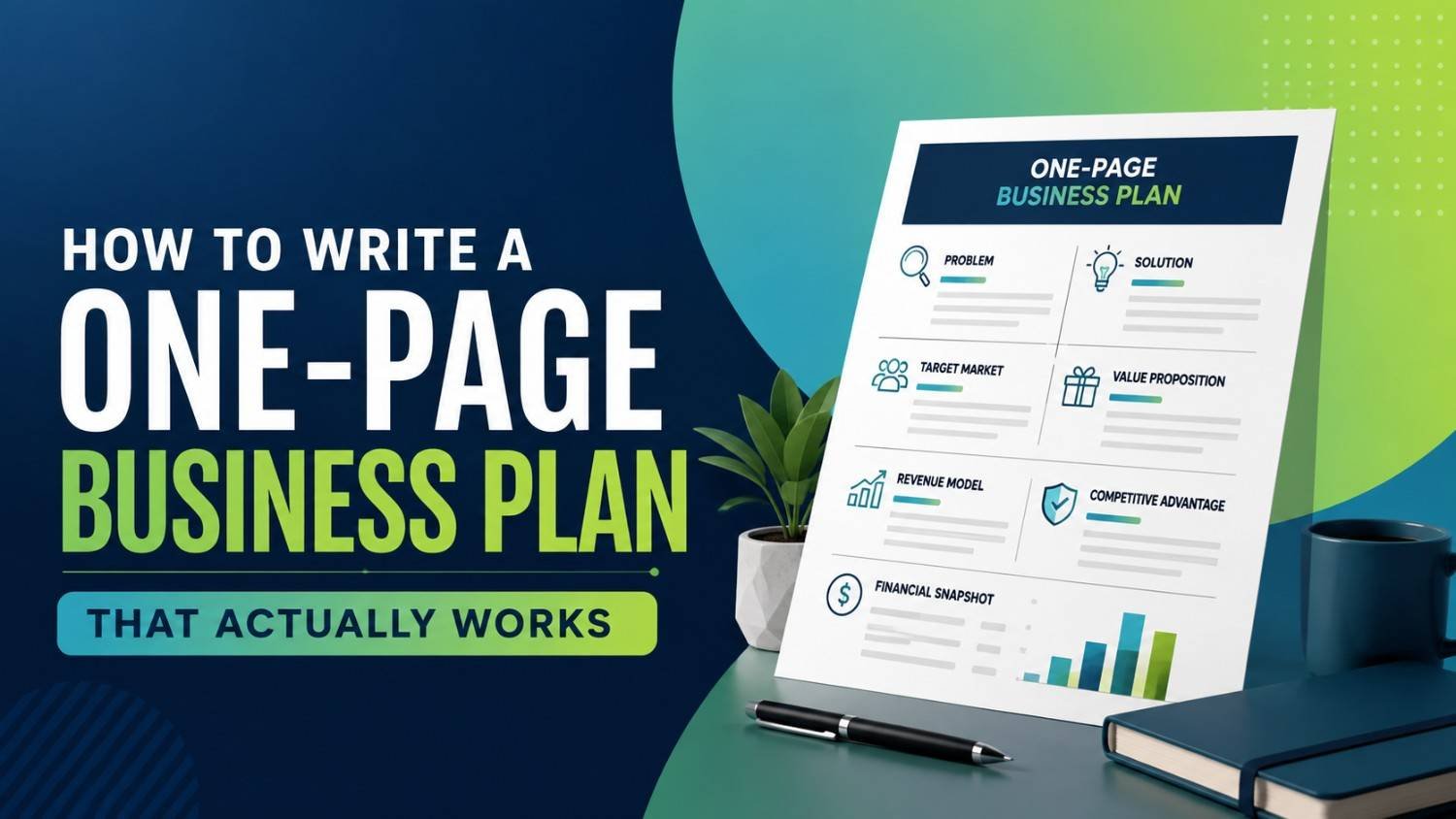
Sample One-Page Business Plan Structure
Although every business is different, a practical one-page plan often includes these sections:
- Business Vision and Mission
- Target Customer
- Value Proposition
- Products or Services
- Revenue Model
- Marketing Strategy
- Competitor Overview
- Financial Goals
- Key Performance Indicators (KPIs)
- 90-Day Action Plan
Keeping everything on one page makes the document easier to reference and update.
How to Measure Success
Making a business plan is kinda just step one, not the whole story. Real success tends to come from measuring what happens next, then adjusting your direction based on what you actually see in the numbers. You’ll want to keep an eye on things like customer acquisition, monthly revenue, conversion rates, profit margins, website traffic, repeat purchases, customer satisfaction, and also cash flow. When you review those indicators, regularly, you can see what’s working and what feels weak, then you can refine your approach and make smarter choices that push long-term Business growth. And yes, a one-page business plan doesn’t really “predict” the future— it’s more like a guide that keeps you anchored, but still gives you the flexibility to react when opportunities shift or problems show up.
Key Takeaways
- A one-page business plan focuses on execution rather than lengthy documentation.
- Clearly define your vision, mission, and target audience.
- Build a strong value proposition based on customer needs.
- Choose a sustainable revenue model.
- Develop a focused marketing strategy.
- Set measurable goals and track progress regularly.
- Review and update your business plan as your company grows.
- Keep the document simple, practical, and action-oriented.
Conclusion
A One-Page Business Plan kinda shows you that solid planning doesn’t have to be like hundreds of pages or months of prep. If you focus on your vision, your customers, the value proposition, your revenue model, your marketing strategy, your financial targets, and the very next action steps, you end up with a workable roadmap, that actually helps with day to day choices. And unlike those traditional plans people write, then forget after the last page is done, a shorter version nudges you to keep checking it, adjust quicker, and stay consistent with execution. Whether you’re starting a first venture or tuning up something you already run, a well made one-page business plan gives the kind of clarity and direction that can turn an idea into lasting growth—yet still stays flexible enough so it can shift as your business shifts.
Frequently Asked Questions
1. What is a one-page business plan?
A One-Page Business Plan is a simplified business planning document that summarizes your vision, target audience, products, marketing strategy, revenue model, financial goals, and action plan on a single page.
2. Is a one-page business plan enough for a startup?
Yes. For many startups and small businesses, a one-page business plan provides enough structure to validate ideas, guide operations, and support decision-making before developing more detailed documentation if needed.
3. How often should I update my business plan?
Review your business plan at least once a month or whenever major business changes occur, such as launching new products, entering new markets, or adjusting financial goals.
4. What is the biggest mistake when writing a business plan?
One of the biggest mistakes is making the plan overly complex. A business plan should be practical, easy to understand, and focused on actions that help achieve measurable business goals.
5. Can investors use a one-page business plan?
Many investors appreciate a concise one-page overview during initial discussions because it quickly communicates the business idea, market opportunity, revenue model, and growth strategy before requesting more detailed information.







Leave a Reply