
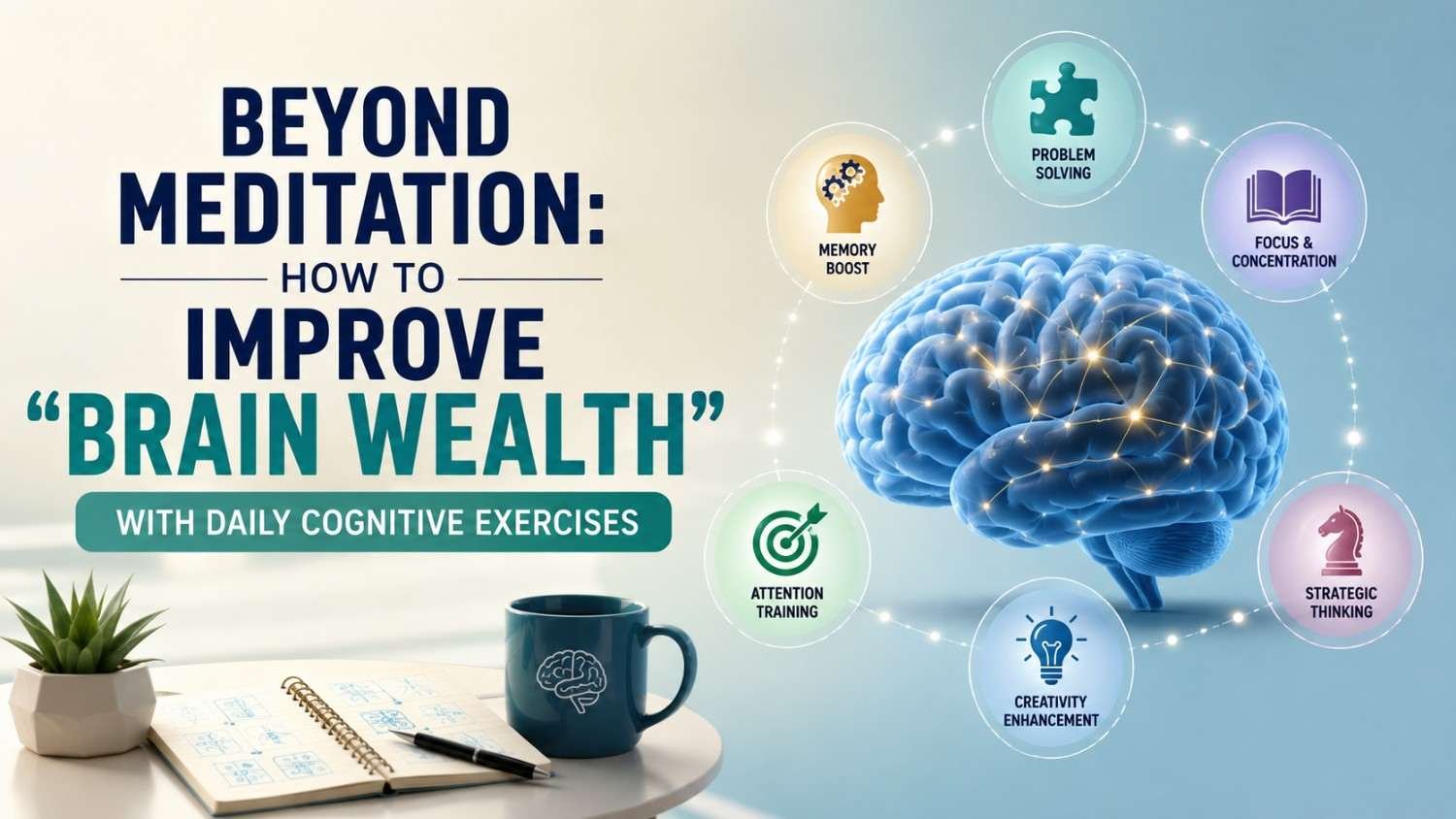
Modern life puts the brain under constant pressure. Notifications, multitasking, information overload, long working hours, and this endless digital entertainment thing can make it hard to stay with just one task for very long. Meditation can help many people develop more awareness, and handle stress, but it is not the only way to support cognitive wellbeing. The brain, like the rest of the body, likes regular activity, useful challenges, recovery, and healthy daily routines. This is where the idea of “brain wealth” becomes kind of handy : instead of only looking at productivity, or intelligence, the point is to build and keep cognitive resources that actually support everyday life.
Improving Brain Health does not mean complicated technology, or hours of intense mental training. It can be simpler than that. Things like learning a new skill, reading actively, tackling unfamiliar problems, exercising regularly, practicing recall, having meaningful conversations, and protecting sleep can provide solid stimulation. Research on cognitive health usually points to a wider lifestyle approach, rather than trusting one “brain exercise” as a magic solution. In this guide, we’ll go through practical cognitive exercises, daily habits, and learning strategies that help you form a stronger cognitive routine, while still keeping expectations realistic.
What Does “Brain Wealth” Actually Mean?
“Brain wealth” i s best understood as a kind of informal way of thinking about the mental resources you gather and safeguard over time. It can come with abilities like attention, recall, reasoning, learning capability, problem solving, language, and mental agility . Compared with financial wealth, brain wealth isn’t something you can pin down with one single number or a neat score. Cognitive performance also tends to shift across age, sleep quality, stress levels, health, education, surroundings and even day-to-day situations that are personal. The point isn’t to become mentally flawless, or to stop every normal age related change. Rather, it is to keep a way of living that gives your brain steady chances to absorb new information, adapt, regain strength, and keep working well. This bigger view matters because brain training apps alone cannot do the work of sleep, movement, social bonding, or an overall healthy routine.
Why Daily Cognitive Stimulation Matters
Your brain stays responsive to experience from start to finish. When you learn something that feels unfamiliar, work through a new problem, practice a skill, or even just wander through a new area, you kind of ask it to process the incoming information and adapt to whatever is required. Still, this doesn’t mean that every tough puzzle will automatically lead to big gains in overall intelligence . A lot of these cognitive skills are more like “narrow tools” ; they tend to get stronger in the exact kind of activity you keep doing . For instance, getting better at one memory game might mostly boost how well you do on similar games. A stronger approach is to mix multiple kinds of mental activity, along with solid lifestyle habits that actually support you.
1. Read Actively Instead of Passively
Reading is one of the simplest ways to challenge the brain, but honestly the way you read matters more than people think. Don’t just slide through pages like it’s automatic, instead pause now and then, and ask yourself what the main argument was, why the author came to a certain conclusion, or how that information ties in with something you already know. It turns the whole thing into a more active learning situation. You can even jot a quick summary after finishing a chapter, just a few lines. And when you try to rebuild the ideas from memory, that effort is usually heavier than rereading the same paragraph. So yeah, active reading becomes one of the most easy, daily brain exercises you can do as an adult.
2. Practice Recall Instead of Constantly Rereading
Memory gets better with retrieval practice, which is basically trying to bring the information back, rather than staring at it again and again. After you read an article, watch an educational video, or sit through a meeting, close everything and explain the key points from memory. You don’t have to keep every small detail. The goal is to train your ability to retrieve what matters. Also, you can use the same method for learning names, vocabulary, concepts, or professional information. This little habit can turn ordinary learning into a kind of daily memory exercise, for adults.
3. Learn Something You Don’t Already Know
Your brain doesn’t always need more endless puzzles. Sometimes the better challenge is to become a beginner again, at least for a while. Learn a language, try beginner photography, mess around with a musical instrument, study history, work through a new software tool, experiment with cooking, or pick up a craft. Just make sure it takes gradual progress, not something you can master immediately. When you learn unfamiliar skills, you feed your mind with new information and you also need attention, memory, problem-solving, and repeated practice. The important factor is consistency rather than difficulty.
4. Challenge Yourself With Mental Flexibility
Mental flexibility is the ability to adapt when situations change, or when your original approach just isnt working, the way you thought it would. You can train it by intentionally looking for other ways to handle ordinary problems. If you tend to schedule your day in one particular pattern, try a different pattern for a while. If you always take the same route, then sometimes check out a different path when it actually makes sense. You can also ask yourself, like, “how would I solve this problem if my first solution wasn’t available.” These kinds of actions can become useful cognitive stimulation stuff, because they push you to step beyond your usual habits, even if only a bit.
5. Use Puzzles as a Supplement
Crosswords, Sudoku, logic challenges, chess, word games, and similar options can be enjoyable ways to strengthen specific thinking skills. Still, it’s important to not exaggerate what they do. Doing well on a puzzle doesn’t automatically mean improvement will transfer everywhere in day to day mental life. Use puzzles as part of a larger routine, not as the whole “mental fitness” program by themselves. A well rounded approach might include puzzles alongside reading, exercise, learning, social time, and consistent sleep.
6. Write by Hand Occasionally
Writing can encourage slower, more deliberate processing than quickly typing everything. Try keeping a short diary, summarizing something you learned, jotting down your goals, or explaining a concept in your own phrasing. You can also practice creating quick summaries without looking back at the original material. The value isnt only in the handwriting aspect. The deeper point is in sorting your thoughts, retrieving information, and expressing ideas clearly. That makes reflective writing a pretty easy option for simple cognitive practice at home.
7. Practice One-Task Focus
Constant multitasking can give this weird impression that you’re being productive, but in reality it makes deep focus harder , not easier. So instead, pick one task and give it all your attention for a set time window. Get rid of annoying notifications, shut down browser pages that you don’t need, and try not to jump between unrelated things over and over. If you notice you can’t stay locked in, start with 15 or 20 minutes, just to see what happens. After that, you can slowly lengthen those stretches of focused work. This can be especially helpful for people who are looking for brain exercises for better attention, without turning their day into some complicated project.
8. Use the “Explain It Simply” Method
One strong learning exercise is to explain a confusing concept using plain words. After you learn something new, imagine you have to tell it to someone who doesn’t have any background knowledge. Find the main point, cut out the extra technical talk, and add a straightforward example. If you can’t explain it without getting stuck , maybe you don’t truly understand it as much as you believed. This style blends comprehension, recall, organization, and communication, which makes it a pretty practical learning tool for both students and professionals.
9. Learn Through Conversation
Real conversations can act like a form of cognitive stimulation that a lot of people just skip over. When you talk about ideas with someone else you have to actually listen, hold details in mind, figure out the meaning, craft a reply, and then revise your thinking when new info shows up. Try discussing books, current interests, work problems, travel moments, or topics you recently studied. Social interaction can also support overall wellbeing, so a meaningful conversation can become a small routine piece for cognitive health, even on normal days.
10. Exercise Your Body to Support Your Brain
Cognitive health is not really separated from physical health, it kind of goes together. Regular movement helps cardiovascular health, and it also tends to line up with benefits for brain function. Things like walking, cycling, swimming, strength training, dancing, and other simple ways of moving can feed an active lifestyle. You don’t necessarily have to chase an extreme workout routine. Steady motion that actually matches your capacity and day to day life can be much more sustainable. If you’re thinking about healthy habits for long-term brain strength, physical activity should be weighed together with mental exercises, and not treated as some fully separate mission.
11. Protect Your Sleep
Sleep is one of the biggest foundations for cognitive performance. Not enough sleep, or poor-quality sleep, can shift attention, learning, mood, reaction speed, and memory. It’s also easy to try to “fix” things with more and more complicated brain drills while you keep sleeping badly. That misses the key piece. When you can, set a regular sleep timing, reduce stimulating stuff close to bedtime, and keep your sleeping space comfortable. When the brain is well-rested it’s just better able to learn and focus.
12. Try Learning in Short Sessions
You don’t have to spend two hours every evening doing cognitive exercises. Short rounds are often easier to hold onto. Like, you could do 15 minutes of reading, 10 minutes practicing a language, 10 minutes recalling what you learned, and then another 20–30 minutes walking. The exact format matters less than making a routine you can repeat. Consistency becomes how to keep your brain active in a practical lifestyle, not another intense productivity project.
13. Make Everyday Tasks More Mentally Engaging
Not all mental activity has to resemble “brain training,” you know. Like, cooking without constantly checking the recipe, estimating costs while you shop, planning a trip, putting a room back in order, learning a new route, or even experimenting with a new recipe can still call on attention, memory, sequence, and choice making. If you do those same everyday things with a bit more focus sometimes, they start feeling more mentally stimulating. This is kind of how mental fitness for beginners gets simpler to slip into daily routines, without it feeling like a chore.
14. Learn a New Language
Language learning bundles multiple mental tasks together. You’re required to remember vocabulary, spot patterns, understand grammar, retrieve words, listen closely, and then respond. At first, progress can feel slow, but steady practice keeps giving your brain chances to handle fresh information again and again. You don’t have to chase fluency right away to benefit from it. Even studying a handful of phrases each day can add novelty, and it also gives your brain a more organized kind of challenge.
15. Change Your Learning Environment
Your brain tends to respond to context, so shifting surroundings can make routine experiences feel kind of fresh. Read somewhere else, go to a museum, wander through a different neighborhood, attend a talk, take an alternate route, or try a strange little activity you haven’t done before. New places make you observe more and adjust on the fly. And no, these experiences don’t need to be pricey or dramatic. Small changes can give you chances to notice details you might normally overlook.
16. Combine Cognitive Exercises With Recovery
More mental stimulation isn’t always better. The brain also needs some downtime, like seriously. If you keep taking in nonstop info, it can make you feel mentally drained, especially when theres work pressure on top of it, and the usual digital distractions everywhere. Meditation might help people who actually enjoy it, but quiet walks , break from screens, time outdoors, hobbies, music, and relaxed get together types of social stuff can work just as well for recovery. The idea is balance really: give the mind a little challenge then let it breathe, not just keep pushing.
17. Reduce constant digital distraction
Your phone can make information instant, but constantly checking it can split your attention into pieces. Consider making periods where notifications are minimized, and closing apps you aren’t using. Instead of grabbing your phone whenever you feel bored, practice short stretches without stimulation. Then normal things like walking, waiting around, or sitting outside can feel way less demanding, like the mind is less on edge. The goal isnt to ban technology, its to make sure it doesn’t end up steering every tiny moment of attention.
18. Build a personal cognitive routine
The best routine is the one you can keep doing. A simple weekly pattern could mix different activities, rather than doing the same exercise every day.
Example Routine
Monday: Read for 20 minutes and summarize what you learned.
Tuesday: Practice a language or unfamiliar skill.
Wednesday: Complete a puzzle or logic activity.
Thursday: Take a longer walk while observing your surroundings.
Friday: Discuss a new topic with a friend or colleague.
Saturday: Learn something through a course, museum, documentary, or practical project.
Sunday: Review what you learned during the week and allow more recovery time.
This variety prevents your routine from becoming repetitive.
Why Variety Matters More Than Repetition
Doing the same puzzle every single day might make you better at that one puzzle, sure, but cognitive wellbeing is more like a bundle of a few different abilities , not just one trick. A broader routine pushes memory, attention, reasoning, language, learning, movement, and social interaction. Plus variety can make the whole routine more interesting, less grindy. Instead of asking “What is the best brain exercise?” try “How can I build a lifestyle that keeps me physically active, mentally switched on, socially close, and properly rested?” That question is way more helpful over time.
What About Brain Training Apps?
Brain training apps can be entertaining, and they may improve performance on the exact tasks they train. Still, people should be careful with any claims that one app will massively boost general intelligence, stop cognitive decline, or magically change every part of thinking. Think of them like optional accessories, not a complete solution. A more varied routine that includes learning, physical activity, sleep, social time, and mentally demanding tasks tends to be a more balanced plan for cognitive function.
Don’t Turn Brain Health Into Another Productivity Contest
It’s pretty easy to accidentally turn cognitive wellness into a new performance race. You might begin tracking reading minutes, puzzle scores, learning streaks, exercise sessions, and even sleep numbers until your “brain health routine” becomes another quiet source of stress. And then, well, the point is gone. The goal should be stable habits that support your overall wellbeing, not hitting some perfect cognitive score every day. Some days will feel productive, some days will be about recovering. Both belong in a healthy lifestyle.
Signs That Your Routine Is Working
You don’t need to feel, like wildly smarter, to understand that your habits can be useful. Rather , just look for practical improvements inside your everyday life. You might see that you’re more steady with learning, better at pulling back information you studied recently, more at ease while focusing on one task, or more open to trying unfamiliar challenges. These are realistic results worth aiming for. And try not to judge your whole cognitive health on just one tough day, or on a single memory slip.
When Cognitive Changes Should Be Talked About With a Professional
Lifestyle habits can back up general brain health, but they’re not a replacement for medical review. If you, or someone close to you, has persistent or getting worse difficulties with memory, thinking, speech , orientation, or everyday functioning, then it matters to talk about it with a qualified healthcare professional. Sudden confusion or big neurological shifts deserve prompt medical attention. Healthy habits are valuable, but they shouldn’t be used to self-diagnose, or to stand in for proper professional care.
A Simple 20-Minute Brain Routine
If you want to begin without stressing yourself out, keep the routine kind of plain. Give yourself five minutes to recall something you learned lately. Then spend another five minutes reading something that’s a bit challenging. Use five minutes to solve a small issue , or practice a new skill. Close it with five minutes of writing a short recap, or explaining the idea out loud. You can slowly extend the routine once it feels comfortable. The goal isn’t to finish a heavy, demanding program. It’s mainly to build a repeatable habit of mental involvement.
Conclusion
Building “brain wealth” is less about finding one perfect exercise, and more about setting up a kind of lifestyle that keeps giving your mind chances to learn, focus, adapt , connect, and yes, recover. Reading actively, practicing recall, picking up unfamiliar skills, sorting through problems, moving your body, exercising, sleeping well, keeping meaningful relationships going, and cutting back on digital noise that you do not really need can all turn into workable pieces of a sustainable Mental Fitness routine. Meditation can still be a solid tool for people who actually like it, but it doesn’t need to be the whole plan. The most realistic route is kinda straightforward: keep learning, keep moving, stay curious, guard your recovery, and select Cognitive Exercises that you can really sustain over the long run.
Frequently Asked Questions
1. What is “brain wealth”?
“Brain wealth” is an informal concept describing the cognitive skills and resources developed and maintained throughout life, including memory, attention, learning, reasoning, language, and mental flexibility.
2. What are the best daily cognitive exercises?
Active recall, reading, learning a new skill, solving unfamiliar problems, writing summaries, practicing a language, and meaningful conversations are practical Cognitive Exercises that can fit into everyday routines.
3. Can brain exercises improve memory?
Some forms of memory practice can improve performance on the specific skills being practiced. However, no single exercise should be viewed as a guaranteed way to dramatically improve overall memory or prevent cognitive decline.
4. Is meditation enough for brain health?
Meditation can support attention, stress management, and wellbeing for some people, but a broader approach is preferable. Physical activity, sufficient sleep, learning, social connection, and healthy lifestyle habits also matter.
5. How much time should I spend on brain exercises each day?
There is no universal required amount. Starting with 10–20 minutes of meaningful mental activity can be practical, especially when combined with regular exercise, learning, good sleep, and other healthy habits.







Leave a Reply